3PL vs. In-House Fulfillment: Calculate Your Break-Even Point
By CartEconomics · Published October 25, 2026
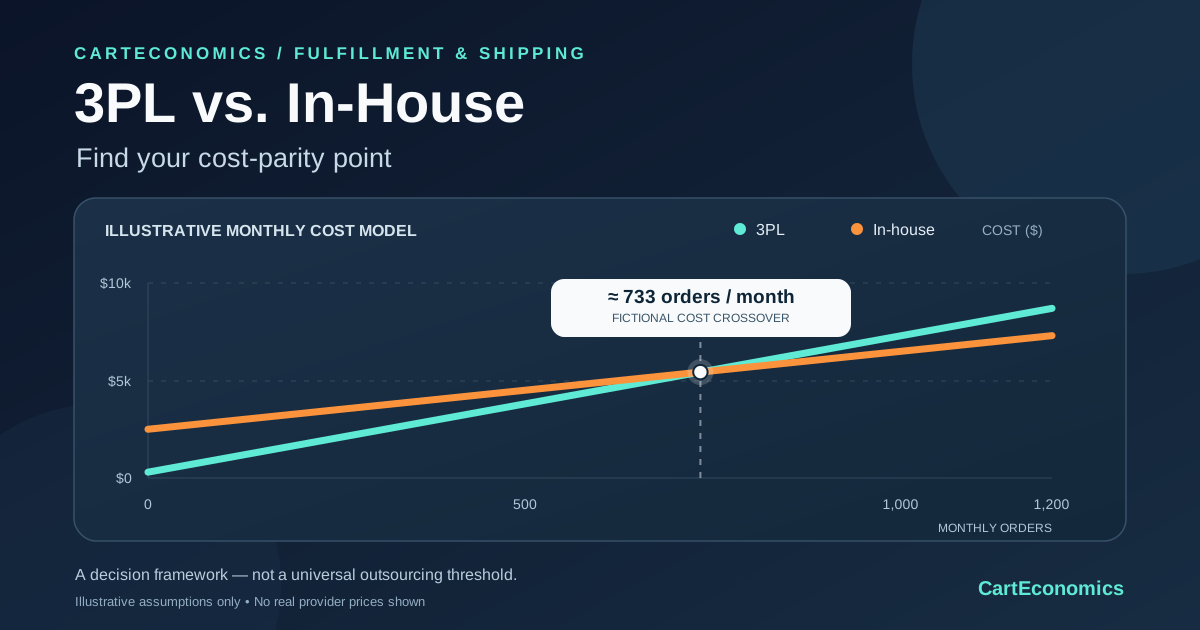
Is it cheaper to pack orders yourself or hire a third-party logistics provider (3PL)? The answer depends less on a universal order-volume threshold and more on how your fixed costs, variable costs, and service needs change as sales grow. Here is a repeatable way to compare both options without pretending that any single provider quote is a market average.
Short answer
Calculate each option's complete monthly fulfillment cost using the same orders, products, destinations, returns, and service scope. In a simplified model, monthly cost is fixed monthly cost plus monthly orders multiplied by variable cost per order. When those two lines cross, you have a cost-parity point, not a universal rule for when to outsource. Contract minimums, staffing steps, and capacity constraints may change the result.
Cost parity is not the same as business break-even
A business break-even analysis asks how many sales are needed to cover expenses with revenue. This article asks a narrower question: at which monthly order volume do two fulfillment choices cost the same? The U.S. Small Business Administration explains the distinction between fixed and variable costs in its break-even guidance. We adapt those cost concepts to compare logistics models, rather than copying a sales-margin formula into an inappropriate setting.
Start with the full cost of each option
Use a common cost scope for both choices. If one quote bundles postage while your self-fulfillment estimate excludes it, the comparison is already misleading. Ask for actual invoices or written quotes where possible, and label estimates separately.
| Cost category | 3PL | In-house |
|---|---|---|
| Labor | Pick/pack and special handling fees | Paid hours, taxes, benefits, supervision |
| Space & equipment | Storage, receiving, possible account fees | Rent, utilities, supplies, equipment, insurance |
| Outbound orders | Quoted processing, packaging and postage | Packaging, purchased postage, handling time |
| Exceptions | Returns, kitting, minimums, setup fees | Returns, damaged items, tools, extra labor |
Remember the true cost of labor. The Bureau of Labor Statistics measures employer compensation as wages and benefits. Your own employer costs will differ from national averages. In a small business, owner packing time is still economically relevant: make its treatment explicit rather than quietly calling that labor free.
Keep shipping assumptions consistent too. For example, USPS Ground Advantage can use dimensional weight for certain domestic parcels exceeding one cubic foot, as described in the USPS Domestic Mail Manual. Never assume every carrier or mail class applies the same rule.
Calculate the monthly fulfillment cost-parity point
For a limited volume range in which each model has roughly constant fixed costs and variable costs per order, use:
3PL monthly cost = F3 + N × V3
In-house monthly cost = FH + N × VH
Cost-parity orders = (FH − F3) / (V3 − VH)
Here, F is monthly fixed cost, V is cost per additional order, and N is monthly orders. This rearrangement only makes sense when the variable-cost difference is nonzero, the result is nonnegative, and the assumptions remain valid at that volume.
If the variable costs are equal, the lines are parallel: there is no crossing unless the fixed costs are also equal, in which case they tie at every modeled volume. If the calculated crossing is negative, there is no positive-volume crossing within this simple model. Do not report either case as a practical order threshold.
Worked example: a cost crossover near 733 orders a month
All four amounts below are invented teaching assumptions, not quotes, benchmarks, or published ShipBob prices. Suppose a merchant has:
- 3PL: $300 fixed monthly plus $7 per order.
- In-house: $2,500 fixed monthly plus $4 per order.
- Identical shipment mix and included costs under both models.
The modeled equality is ($2,500 − $300) ÷ ($7 − $4) = 733.3 monthly orders. Because actual orders are whole numbers, the cheaper option flips between 733 and 734 orders under these assumptions.
| Monthly orders | 3PL | In-house | Lower modeled cost |
|---|---|---|---|
| 250 | $2,050 | $3,500 | 3PL |
| 500 | $3,800 | $4,500 | 3PL |
| 750 | $5,550 | $5,500 | In-house |
| 1,000 | $7,300 | $6,500 | In-house |
Bar lengths compare modeled total cost on the same $0–$7,500 scale. This is an illustration, not an observed market trend.
500 orders/month
1,000 orders/month
At 500 orders the modeled 3PL costs $3,800 versus $4,500 in-house. At 1,000, the cost ordering reverses. Neither outcome should be generalized to real merchants without their own quotes, actual staffing costs, and operational needs.
Five ways a simple break-even calculation can mislead you
- Minimum commitments: Some 3PL agreements have invoice floors or minimum charges. Model the contract's actual billing rule; do not add a minimum fee on top of already-billed usage when it is merely a floor.
- Step costs: An internal warehouse may need another shift, lease, or packing station at certain volumes. A single linear formula cannot capture that jump.
- Peak-season mix: A monthly average hides spikes, expedited orders, oversized packages, and new storage needs.
- One-off and exit costs: Inventory transfers, setup, integrations, onboarding, and contract termination can affect a twelve-month decision even when monthly costs look close.
- Service quality: Order cutoffs, inventory accuracy, delivery promises, returns experience, and control matter alongside invoice totals. Avoid converting an unverified service claim into a dollar saving.
How to compare your own fulfillment options
- Choose a comparison period, such as the next 12 months, and forecast both average and peak monthly orders.
- Use the same products, units per order, package dimensions, shipping destinations, and service levels on both sides.
- Estimate your fully loaded in-house labor, space, software, and packaging cost, including realistic capacity steps.
- Get a written 3PL quote and identify receiving, storage, outbound shipping, returns, minimums, and other charges.
- Calculate each option at several volumes rather than trusting a single break-even threshold.
- Document unpriced risks and service differences separately from the numeric comparison.
If you already have a 3PL quote, use our 3PL Fulfillment Cost Calculator to estimate its full monthly cost from your own numbers. Our Fulfillment Cost Comparison Calculator is useful for a narrower outbound-order scenario: it intentionally excludes some storage, receiving, returns, and other costs, so it does not calculate the full cost-parity point described here.
Need to compare two actual 3PL proposals? Start with our separate 500-orders-per-month quote comparison worksheet. That article focuses on comparing providers, while this guide focuses on deciding whether to outsource at all.
If outsourcing makes sense, evaluate provider fit next
Price is only one screening factor. Check warehouse locations, platform integrations, product restrictions, minimums, return processing, service terms, and whether the quote covers your actual order profile. Our researched 3PL directory can help create a shortlist. For example, our ShipBob provider profile summarizes documented capabilities and links to a separately disclosed quote request on that provider's profile page. No provider's rates are assumed in the calculations in this article.
Frequently asked questions
At how many orders should I switch to a 3PL?
There is no reliable universal threshold. Compare your current fixed and variable costs against real quotes, model several order volumes, and consider capacity and service requirements.
Does a cheaper 3PL pick-and-pack fee mean a cheaper 3PL?
No. Receiving, storage, packaging, shipping, returns, contractual minimums, and account fees can change the total. Compare the same cost categories on both sides.
Is outsourcing always cheaper as order volume rises?
No. That depends on how fixed expenses, marginal labor, carrier rates, warehouse capacity, and provider pricing change. The fictional crossover in this article is not an industry rule.
Sources
- U.S. Small Business Administration — Break-even analysis — Fixed and variable cost concepts; the fulfillment cost-parity formula here is our own adaptation, not the SBA's sales break-even formula.
- U.S. Bureau of Labor Statistics — Employer Costs for Employee Compensation — Explains why wages alone do not measure the entire employer compensation cost. Do not treat nationwide averages as your business's labor cost.
- USPS Postal Explorer — Ground Advantage dimensional-weight pricing — Carrier-specific domestic parcel rules. Actual rates depend on the service, weight, dimensions, and destination.